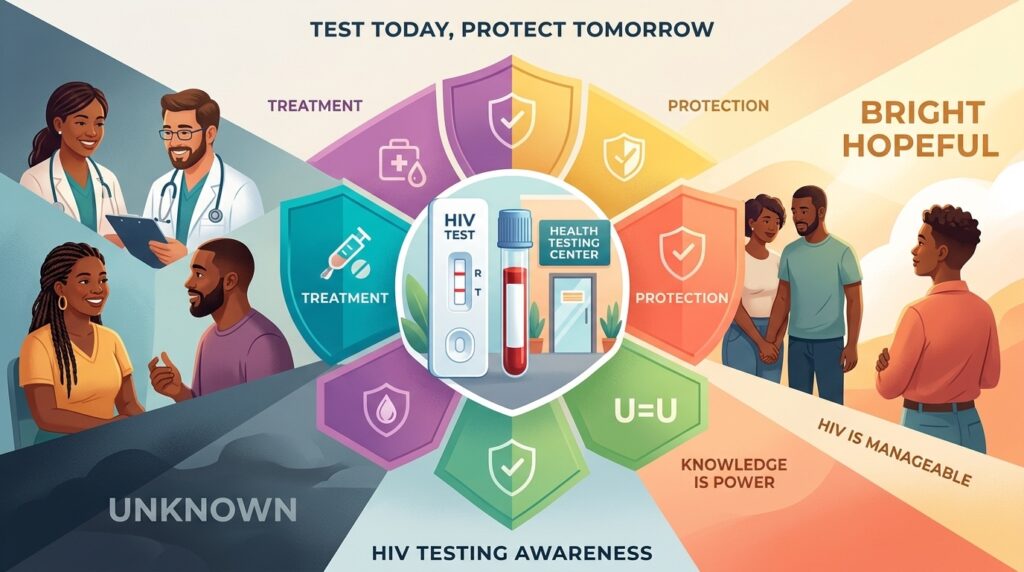
HIV is no longer a death sentence. With modern treatment, people living with HIV can live long, healthy lives and cannot transmit the virus to sexual partners.
But that’s only possible if you know your status.
Why Testing Matters
An estimated 1 in 7 people living with HIV in the U.S. don’t know they’re infected. That means they aren’t getting treatment, their health is at risk, and they can unknowingly transmit the virus to partners.
Early detection changes everything. When HIV is caught early and treated with antiretroviral medications, people can achieve “undetectable” viral loads, meaning:
- The virus can’t be transmitted sexually (Undetectable = Untransmittable, or U=U)
- They stay healthy and avoid AIDS-related illness
- They live normal lifespans
Who Should Get Tested
The CDC recommends that everyone between ages 13-64 get tested for HIV at least once as part of routine healthcare.
You should test more frequently (every 3-6 months) if you:
- Have multiple sexual partners
- Have unprotected sex
- Share needles for drug use
- Have been diagnosed with another STI
- Are a man who has sex with men
- Have a partner living with HIV
How HIV Is Transmitted
HIV spreads through:
- Unprotected sex (vaginal or anal)
- Sharing needles or syringes
- Mother to child during pregnancy, birth, or breastfeeding (preventable with treatment)
HIV is NOT transmitted through:
- Casual contact (hugging, kissing, sharing food)
- Mosquito bites
- Saliva, sweat, or tears
- Toilet seats
Types of HIV Tests
Antibody Tests (most common):
Blood or oral swab. Detects antibodies your body makes to fight HIV. Can take 3-12 weeks after exposure to show positive (called the “window period”).
Antigen/Antibody Tests:
Blood test that detects both HIV antibodies and antigens. Can detect HIV 2-6 weeks after exposure.
Nucleic Acid Tests (NAT):
Blood test that looks for the actual virus. Can detect HIV 1-4 weeks after exposure. Usually used when recent exposure is suspected.
Where to Get Tested
- Five Health Home Testing: Order a free kit at 5-health.com
- Community Health Centers: Sliding-scale or free testing
- Miami-Dade Health Department: Free testing at multiple locations
- Pharmacies: CVS and Walgreens offer rapid testing
What If You Test Positive?
First: HIV is treatable. You can live a full, healthy life.
Five Health will immediately connect you with:
- HIV specialists (infectious disease doctors)
- Free or low-cost medication through patient assistance programs
- Case management to help you navigate treatment
- Mental health support
- Partner notification services (confidential)
Starting treatment quickly is key. Modern HIV medications are highly effective, usually just one pill per day, with minimal side effects.
Prevention Works
If you’re HIV-negative and want to stay that way:
- Use condoms consistently
- Get tested regularly
- Consider PrEP (pre-exposure prophylaxis)—a daily pill that prevents HIV infection by 99%
- Don’t share needles
Knowledge is power. Get tested.
Order a free HIV test at 5-health.com or call 305-354-9295
| Subscribe to our newsletter for quarterly updates |