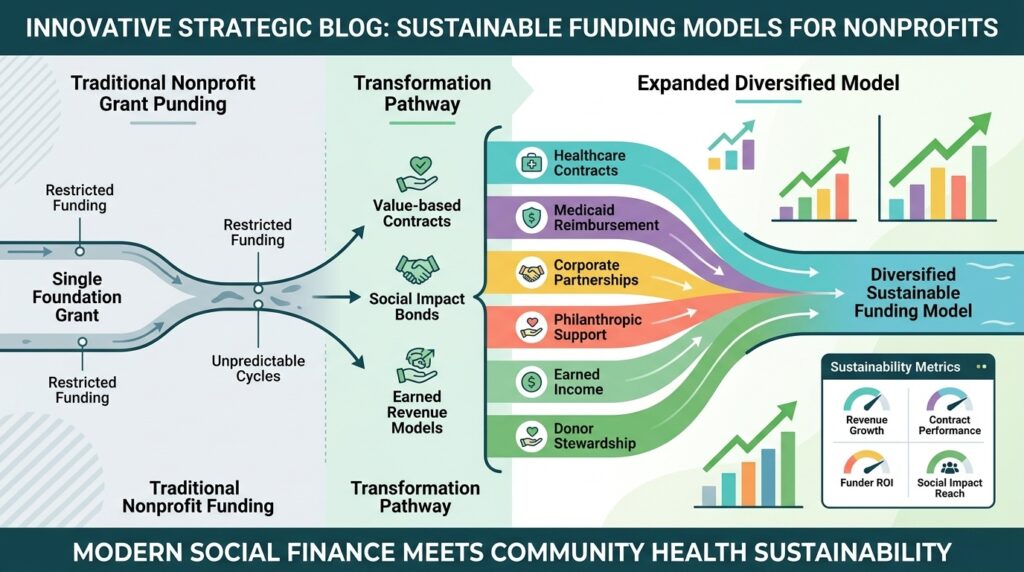
Community health organizations face persistent funding challenges: short grant cycles, restricted funding, and reliance on philanthropy that can disappear.
Five Health is piloting innovative funding models that create sustainability while maintaining our mission. This post shares what we’re learning.
The Traditional Funding Problem
Most community health organizations depend heavily on:
- Foundation grants (typically 1-3 years, highly competitive)
- Government contracts (bureaucratic, often underfunded)
- Individual donations (unpredictable, labor-intensive to cultivate)
This creates:
- Financial instability and planning challenges
- Staff burnout from constant grant-writing
- Program interruptions when funding ends
- Difficulty investing in infrastructure and technology
Model 1: Value-Based Contracts with Healthcare Systems
We’re partnering with hospitals and insurance plans on outcomes-based contracts. Five Health receives payment for:
- Reducing avoidable ER visits among high-utilizing patients
- Improving medication adherence for chronic disease patients
- Successfully linking uninsured patients to coverage
- Preventing disease progression through early intervention
Why it works: Healthcare systems save money (ER visits cost $1,200+ vs. our $275 intervention cost), and we generate reliable revenue.
Early results: Our Jackson Health partnership generated $127,000 in year one, with a 23% reduction in ER utilization among enrolled patients.
Model 2: Social Impact Bonds (Pay for Success)
We’re exploring a social impact bond structure where private investors fund program expansion upfront. If we achieve predetermined outcomes (e.g., employment rates, health improvements), government repays investors with returns.
Why it works: Shifts financial risk from government to investors, allows upfront capital for scaling, and focuses everyone on measurable outcomes.
Status: In development with Miami-Dade County for STRIDE Academy expansion.
Model 3: Medicaid Reimbursement for CHW Services
Florida recently expanded Medicaid reimbursement for Community Health Worker services. We’re becoming a Medicaid-enrolled provider to bill for CHW interventions.
Why it works: Creates sustainable revenue stream for core program operations; aligns incentives with health outcomes.
Projected impact: $180K annual revenue by end of 2027.
Model 4: Corporate Partnerships
We’re developing fee-for-service partnerships with employers who want to improve employee health and reduce healthcare costs. Services include:
- On-site health screenings and education
- Employee assistance program navigation
- Chronic disease management support
- Mental health and substance use resources
Why it works: Employers get healthier, more productive workforces; we generate unrestricted revenue.
Model 5: Philanthropic + Earned Revenue Hybrid
Our sustainable target: 50% earned revenue (healthcare contracts, Medicaid, corporate partnerships) + 50% philanthropic (foundations, individual donors, government grants).
This balance provides:
- Financial stability from earned revenue
- Flexibility from philanthropic support to pilot innovations and serve populations that don’t generate revenue
What Funders Can Do
Support infrastructure: Fund our transition to value-based contracting—data systems, evaluation capacity, contract negotiation support.
Provide bridge funding: Support programs during the lag time between launching and achieving outcomes that trigger payments.
Invest in pilots: Fund innovation that hasn’t yet proven ROI but shows promise.
Advocate for policy change: Support Medicaid reimbursement expansion, social impact bond legislation, and value-based payment models.
The Vision
By 2028, Five Health aims for 60% earned revenue while maintaining our commitment to serving everyone regardless of ability to pay.
Sustainability isn’t mission drift—it’s mission protection.
Contact Dr. Ichite at amanda@5-health.com to discuss funding model innovation partnerships.
| Subscribe to our newsletter for quarterly updates |