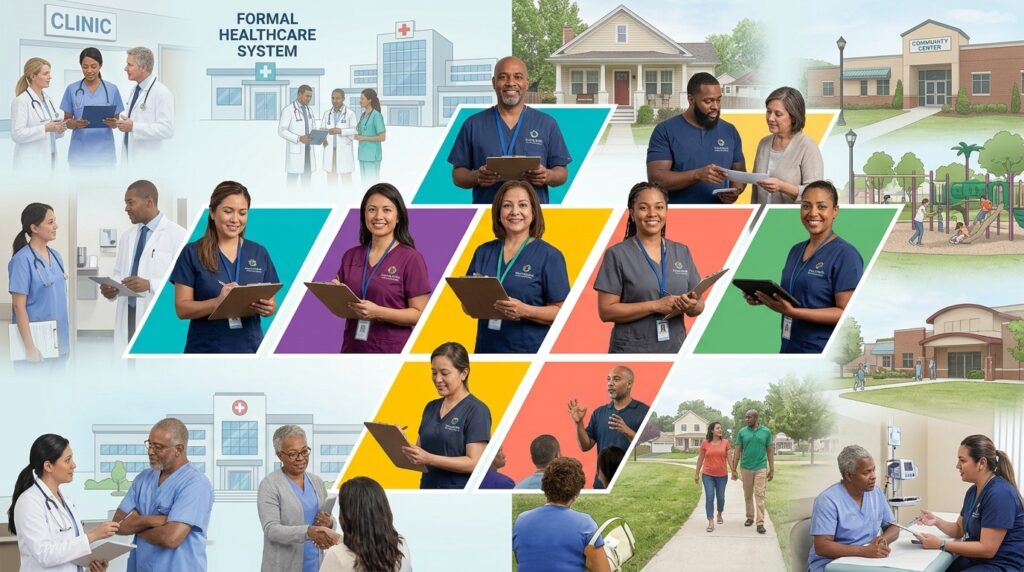
Community Health Workers (CHWs) are the unsung heroes of public health. They’re the bridge between healthcare systems and the communities those systems struggle to reach.
Five Health’s model depends on CHWs, and this post explains why.
What CHWs Do
CHWs are frontline public health workers who typically come from the communities they serve. They:
- Conduct outreach and education in non-clinical settings
- Help people navigate healthcare and social service systems
- Provide basic health screenings
- Connect people to resources
- Follow up to ensure people get the care they need
- Advocate for community health needs
Why CHWs Work
Trust: People are more likely to engage with healthcare information from someone who shares their lived experience, language, and cultural context.
Access: CHWs go where traditional providers don’t—homes, churches, barbershops, community centers.
Navigation: Healthcare is complex. CHWs translate medical jargon, help people understand their options, and remove logistical barriers.
Cost-Effectiveness: CHWs reduce unnecessary ER visits, improve chronic disease management, and increase preventive care utilization—all of which save money.
Five Health’s CHW Model
We employ 6 full-time CHWs and partner with 32 trained Bridge Builders (community volunteers who function as CHWs).
Training: CHWs receive 160 hours of training in public health fundamentals, motivational interviewing, resource navigation, chronic disease management, and cultural humility.
Supervision: CHWs meet weekly with clinical staff for case consultation and ongoing education.
Compensation: Five Health pays CHWs $18-22/hour with benefits—above industry average but still below what their value justifies.
Impact Data
Outcomes attributable to CHW interventions (Q1-Q2 2026):
- 94% successful linkage to primary care
- 86% medication adherence improvement
- 78% kept follow-up appointments (vs. 41% national average)
- $847,000 estimated savings in avoided ER visits
The Broader CHW Workforce Challenge
Despite proven effectiveness, CHWs face systemic barriers:
- Inconsistent certification and training standards
- Low wages and limited benefits
- Lack of healthcare system integration
- Limited Medicaid reimbursement
- Few career advancement pathways
Policy Advocacy
Five Health advocates for:
- State-level CHW certification standards
- Medicaid reimbursement for CHW services
- Dedicated funding streams for CHW workforce development
- Integration of CHWs into healthcare teams
Investment Opportunity
Funder support for CHW programs generates measurable ROI through:
- Reduced healthcare costs
- Improved population health outcomes
- Stronger community-health system relationships
- Job creation in underserved communities
To discuss CHW program sponsorship or policy advocacy partnerships, contact Dr. Ichite at amanda@5-health.com.
| Subscribe to our newsletter for quarterly updates |