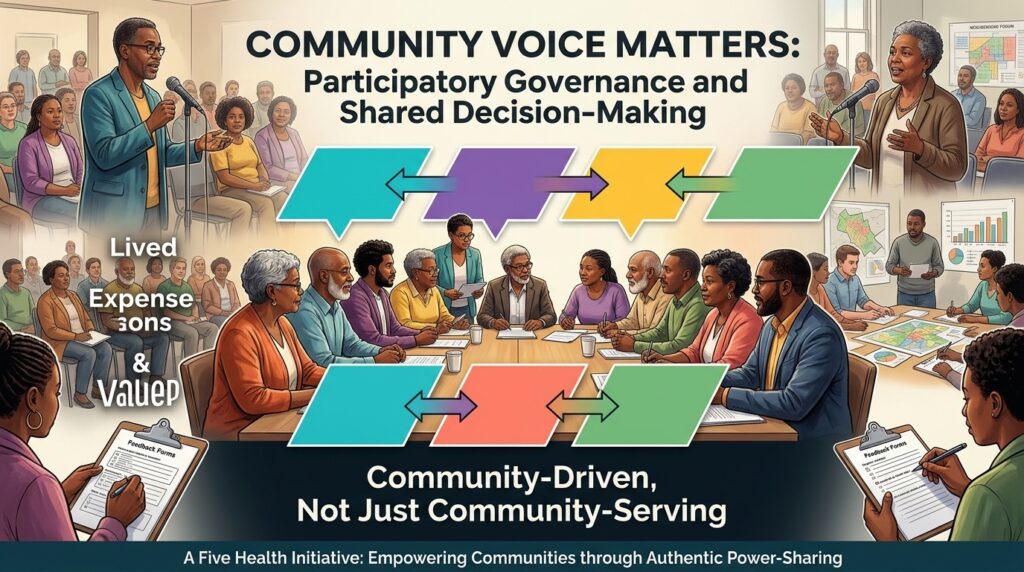
Community health organizations often talk about being “community-driven.” Five Health is working to actually be it.
This post describes how we center community voice in decision-making.
The Problem with Traditional Models
Many nonprofits serving communities are led by people who don’t live in those communities. Boards are filled with donors and professionals, not residents. Programs are designed in conference rooms, not kitchen tables.
The result: well-intentioned programs that miss the mark because they’re not informed by lived experience.
Our Approach
- Community Advisory Council
We’ve established a Community Advisory Council of 12 Miami-Dade residents who represent the demographics and neighborhoods we serve. Members receive stipends for their time.
The Council:
- Reviews new program proposals
- Provides feedback on messaging and outreach strategies
- Identifies barriers and gaps we’re missing
- Connects us with community partners
- Holds us accountable to our mission
Council members have veto power over any program they believe won’t serve the community well.
- Program Participant Feedback
Every person who uses our services receives a feedback survey (via text, email, or phone). We ask:
- Did this service meet your needs?
- How could it be better?
- What other support do you need?
- Would you recommend us to others?
Quarterly, we aggregate and analyze feedback and make programmatic adjustments.
Example: Home Access Program users told us packaging felt “too medical” and intimidating. We redesigned it to look like a wellness kit. Return rates increased 12%.
- Community Listening Sessions
Twice yearly, we host open community forums where residents can:
- Learn about Five Health’s work
- Share health concerns and priorities
- Suggest new programs or partnerships
- Voice complaints or concerns
We provide food, childcare, and transportation. Sessions are held in community spaces, not our office.
- Staff Who Reflect the Community
75% of Five Health staff live in Miami-Dade, and 60% identify as Black or Latinx. Our Community Health Workers are recruited from the neighborhoods they serve.
Lived experience isn’t just valuable—it’s essential.
What We’ve Learned
Success: Community Advisory Council identified that our evening hours conflicted with family dinner time in many cultures. We shifted to late afternoon appointments and saw attendance improve 34%.
Challenge: Recruiting diverse Council members without tokenizing or overburdening community leaders already stretched thin. We now provide stipends and limit time commitments.
Success: Listening sessions revealed that substance use support was a priority we hadn’t addressed. We developed partnerships with recovery organizations and harm reduction programs.
The Work Ahead
We’re exploring:
- Community representation on our Board of Directors
- Participatory budgeting where community members help allocate funding
- Training community members as paid peer researchers for program evaluation
Why Funders Should Care
Community-driven organizations are more effective because:
- Programs actually meet community needs
- Trust and engagement are higher
- Solutions are culturally grounded
- Sustainability improves when community owns the work
Invest in infrastructure that supports community governance: stipends for community advisors, facilitation training, evaluation systems that capture community voice.
Contact amanda@5-health.com to learn more about our community governance model.
| Subscribe to our newsletter for quarterly updates |